What Cerbi changes
Find it before deployment. Stop it at runtime. Prove the policy was enforced.
SAST, OpenTelemetry processors, logger filters, and downstream redaction are useful controls. Cerbi connects the governance lifecycle across source discovery, deliberate targeting, multiple enforcement boundaries, rollout, and retained evidence.
Start with evidence
Cerbi Scanner can surface concrete logging risk before a runtime deployment, giving the pilot a measurable problem instead of a category-level promise.
Treat policy as a lifecycle
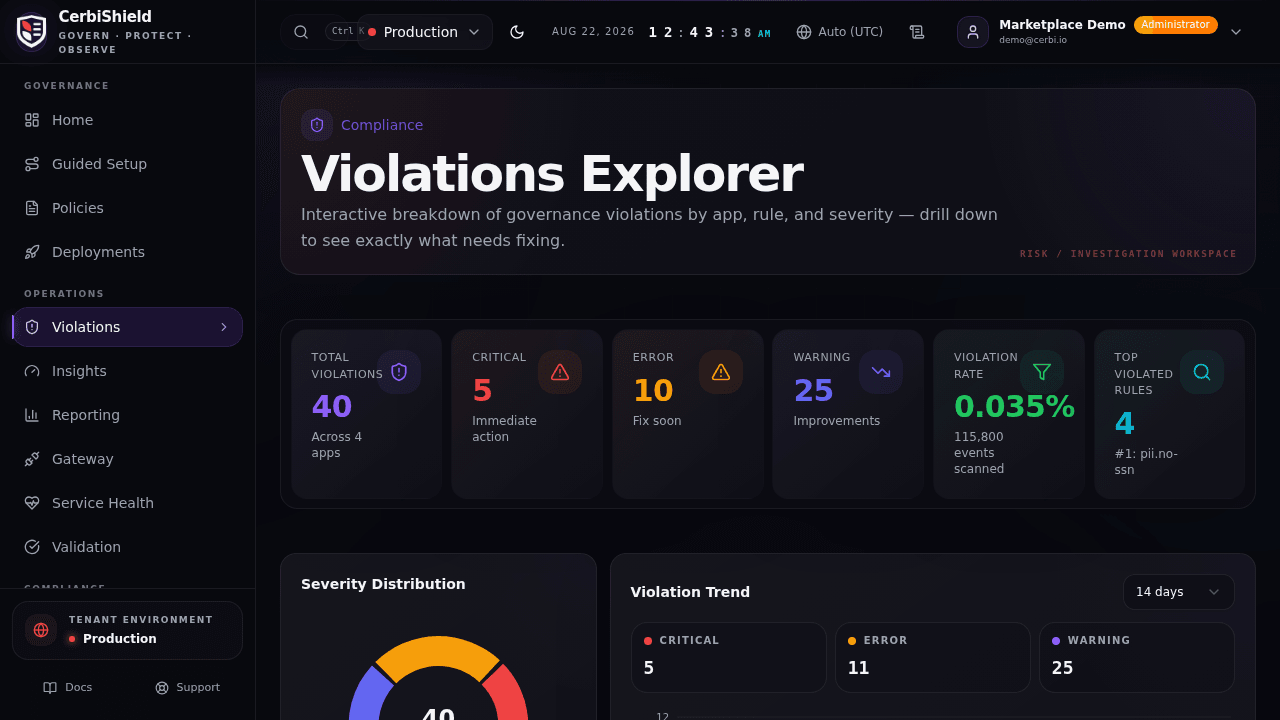
CerbiShield manages governance rules, validation, targeting, deployment history, violations, reporting, audit, and operational evidence as one system.
Choose the enforcement boundary
Use CerbiStream inside selected applications, Cerbi Gateway on selected OpenTelemetry traffic, or both under the same governance program.
Keep the observability investment
Cerbi governs telemetry before the sink without asking you to replace Splunk, Datadog, Elastic, Azure Monitor, OpenTelemetry, SIEM, APM, dashboards, or alerts.
Keep runtime processing customer-hosted
CerbiShield and the Marketplace Gateway architecture run in the customer Azure environment rather than requiring a shared Cerbi raw-log relay.
Make governance reviewable
Retain bounded evidence around policy, deployment, violations, validation, reporting, audit activity, and platform health so teams can review what actually happened.