Sensitive data exposure
Find logging patterns and fields that should not travel downstream, then enforce the appropriate redact, drop, block, or policy decision at the selected boundary.
Use cases
Healthcare, payments, SaaS, privacy, and platform engineering have different regulatory and operating contexts, but the telemetry problems often reduce to the same four questions: what should be found, governed, enforced, and proven?
Not every use case should begin with the same product. Discovery-heavy problems start with Scanner. Existing OTLP adoption can start at Gateway. Evidence-heavy programs may begin with the CerbiShield operating model.
Find logging patterns and fields that should not travel downstream, then enforce the appropriate redact, drop, block, or policy decision at the selected boundary.
Turn naming, required fields, prohibited fields, and schema expectations into explicit policy instead of relying on team-by-team conventions.
Govern selected OpenTelemetry traffic through a customer-hosted Gateway when adding an application SDK everywhere is the wrong rollout strategy.
Keep policy, versions, targets, deployments, violations, exceptions, and audit context connected to the control instead of reconstructing them during review.
Regardless of industry, the product needs to show where policy failed, which workload and rule were involved, and enough context to decide what should change next.
See the Dashboard journey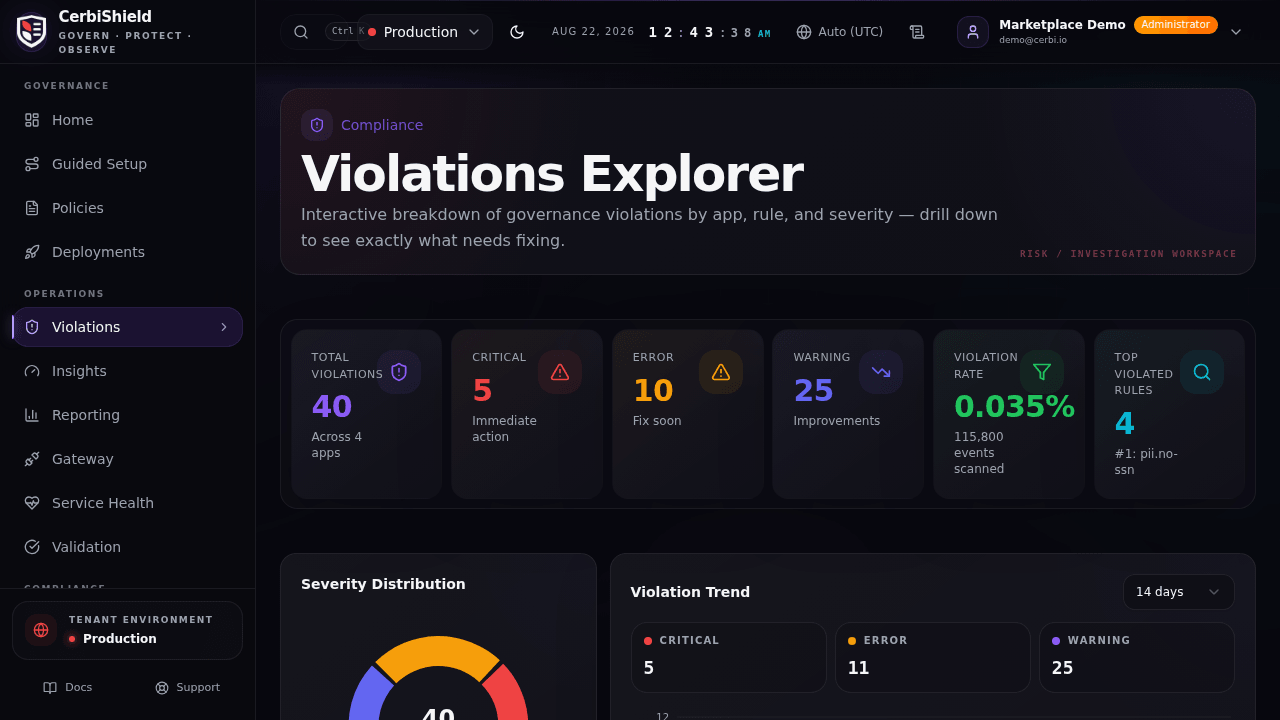
Healthcare
Constraint
PHI-sensitive logs, distributed services, audit requirements
Governance path
Scanner → policy → Stream or Gateway → Evidence
Use Scanner to find risky logging before deployment, then govern selected sensitive fields at the application or OTLP boundary while keeping the existing observability system downstream.
Useful outcomes
Supports logging controls in HIPAA-sensitive environments. It is not a HIPAA certification.
Payments
Constraint
Card data, tokens, secrets, exception payloads
Governance path
Scanner → prohibited-field policy → enforce → investigate
Find payment-field and credential risk in source, then apply policy before governed telemetry reaches long-term storage, analytics, or secondary destinations.
Useful outcomes
Supports reduced cardholder-data exposure in logs. It is not a PCI DSS certification.
Enterprise SaaS
Constraint
Many teams, languages, schemas, and exception patterns
Governance path
Scanner → shared policy → mixed Stream / Gateway estate
Use a shared CerbiShield policy lifecycle while allowing selected applications to use in-process enforcement and existing OTLP workloads to use Gateway where appropriate.
Useful outcomes
Designed for multi-team environments that need shared telemetry standards without replacing every team's logging framework.
Privacy & minimization
Constraint
PII, retention pressure, multiple downstream copies
Governance path
Discover → minimize → enforce → prove
Identify personal-data risk in source and govern selected fields before they continue to analytics, archives, SIEMs, or other secondary destinations.
Useful outcomes
Supports privacy-conscious logging practices. It is not a GDPR certification or legal advice.
Platform engineering
Constraint
Existing loggers, existing OTel, existing destinations
Governance path
Start where the estate already is
Use Scanner for discovery, CerbiShield for policy, Stream for selected applications, and Gateway for selected OTLP estates while leaving the downstream observability strategy intact.
Useful outcomes
A practical fit for platform teams responsible for standards across many services and engineering groups.
Security & audit
Constraint
Evidence gaps, undocumented exceptions, unclear rollout state
Governance path
Policy → deployment → violations → evidence
Use CerbiShield to keep the governance lifecycle visible so reviewers can understand which control was intended, where it was active, what violated it, and what changed later.
Useful outcomes
Supports evidence for internal logging controls. It is not a SOC 2 or ISO 27001 certification.
The industry context matters, but the first proof should stay bounded enough that every policy decision can be explained.
Find
One actual risk
Govern
One explicit rule
Enforce
One selected boundary
Prove
One evidence chain
Operational proof
Whether the entry point is regulated telemetry, an OTLP estate, platform standards, or audit preparation, teams operate the same posture, enforcement, investigation, and evidence lifecycle in CerbiShield.
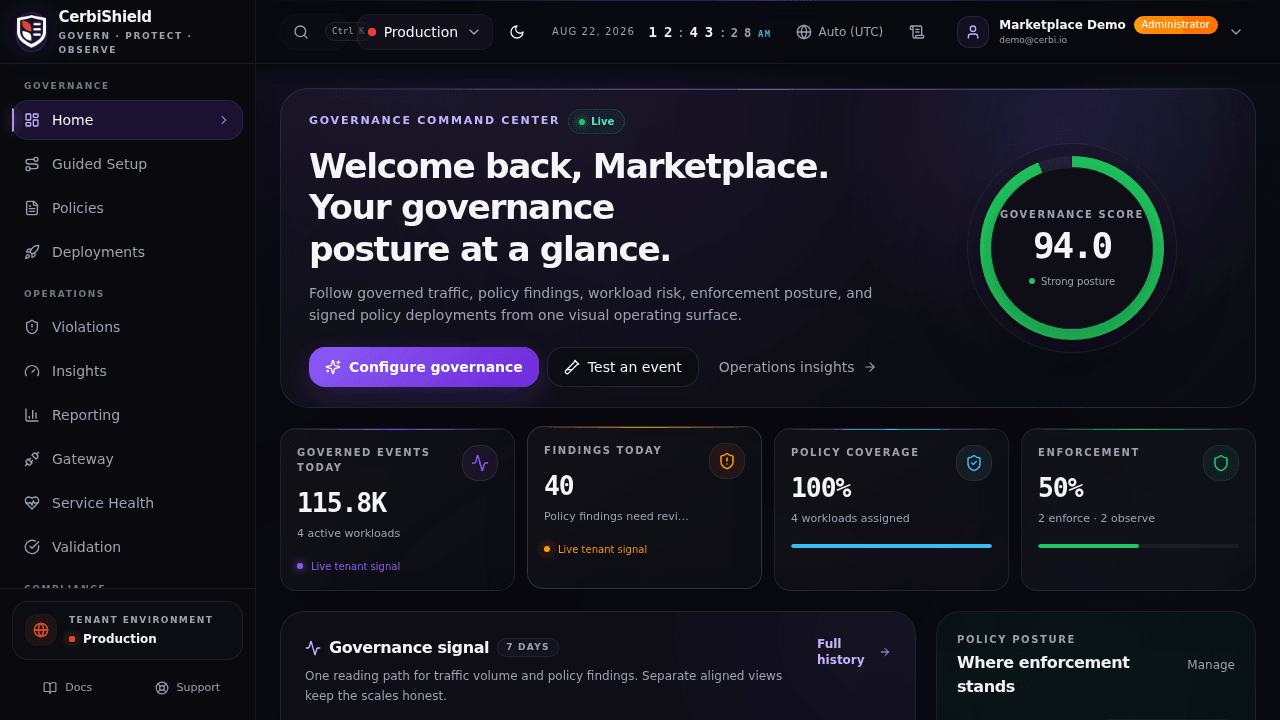
Use CerbiStream inside selected applications, Cerbi Gateway at the OpenTelemetry boundary, or both. CerbiShield keeps policy, rollout, violations, audit, and evidence under one governance program.