
40%
Log spend eliminated
Median reduction in paid log volume for early adopters in the first 90 days.
CI + runtime guardrails for structured logging and automatic redaction—without swapping out your log destinations or observability tools.
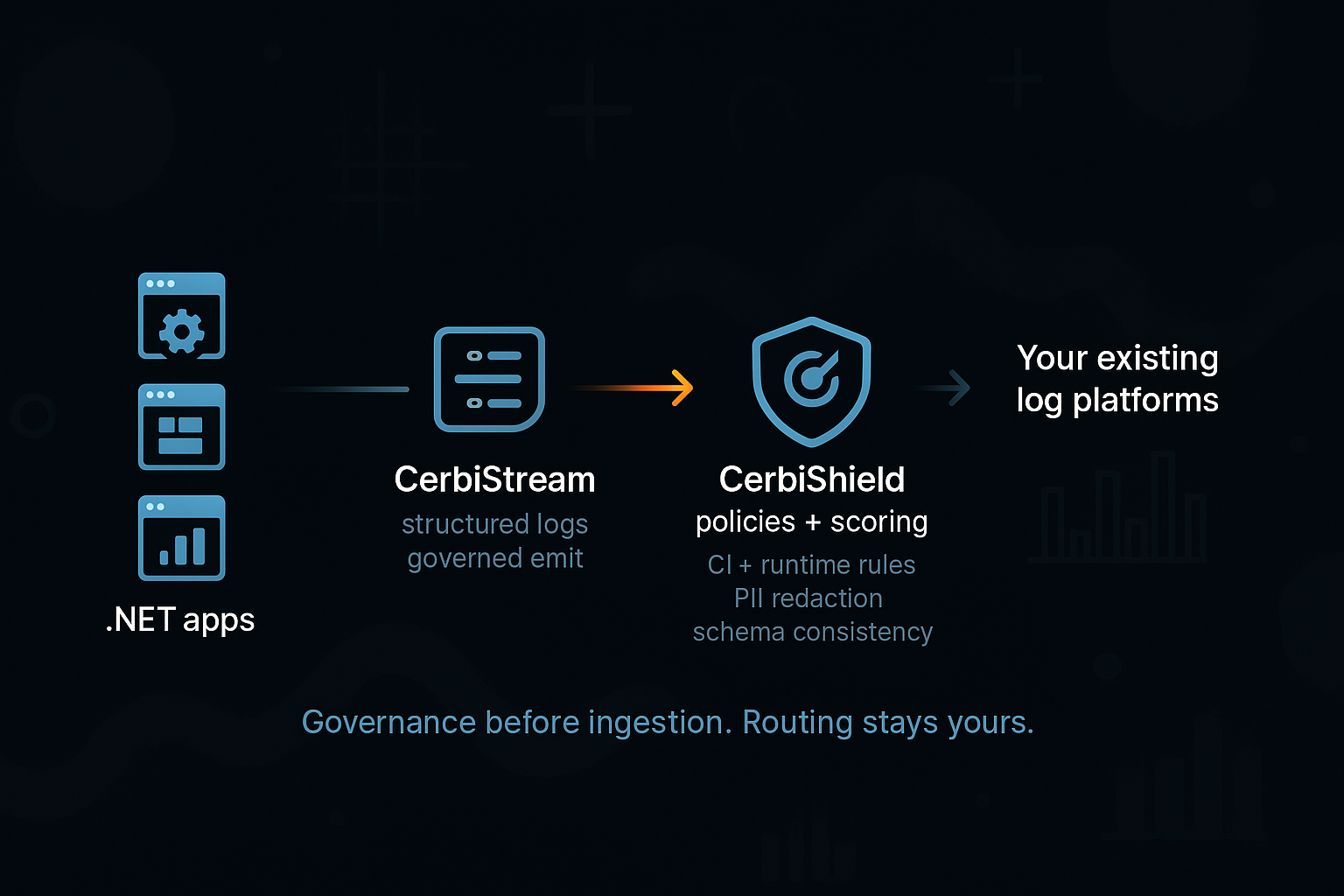
Cerbi is a tenant-hosted logging governance control plane. CerbiStream, the Governance Analyzer, and runtime enforcement stay free on NuGet; paid value lives in CerbiShield dashboards, lifecycle, scoring visibility, deployment, reporting, and RBAC.
Median reduction in paid log volume for early adopters in the first 90 days.
Compliance checks passed on first audit when teams enforced Cerbi governance profiles.
Time-to-resolution improvement after instrumenting runbooks with governed, searchable logs.
Figures are illustrative pilot outcomes from governed schemas, redaction posture, and audited evidence; your pipeline and controls will change results.
Cost, compliance, and quality wins come from governing before ingestion—while your routing to log destinations stays yours.
Drop noisy fields and junk events at the source to trim ~40% of paid ingestion without changing collectors.
Versioned profiles, deployment history, and runtime enforcement create an auditable trail for regulated workloads.
Schema guardrails and governance scores keep dashboards, alerts, and ML features consistent across releases.
CerbiStream + CerbiShield provide tenant-hosted governance. You keep routing logs to any vendors or storage you choose.
Author required/forbidden/sensitive fields and redaction rules as JSON. Profiles live in your repos for review and promotion.
NuGet analyzers block schema drift in CI; runtime validators tag/redact violations without taking over your collectors or log destinations.
CerbiShield tracks deployment history, RBAC, and governance scores so you can show improvements over time—while your log routing stays unchanged.
Dashboard-first visuals that show how Cerbi governs before ingestion while you keep routing to your log destinations.
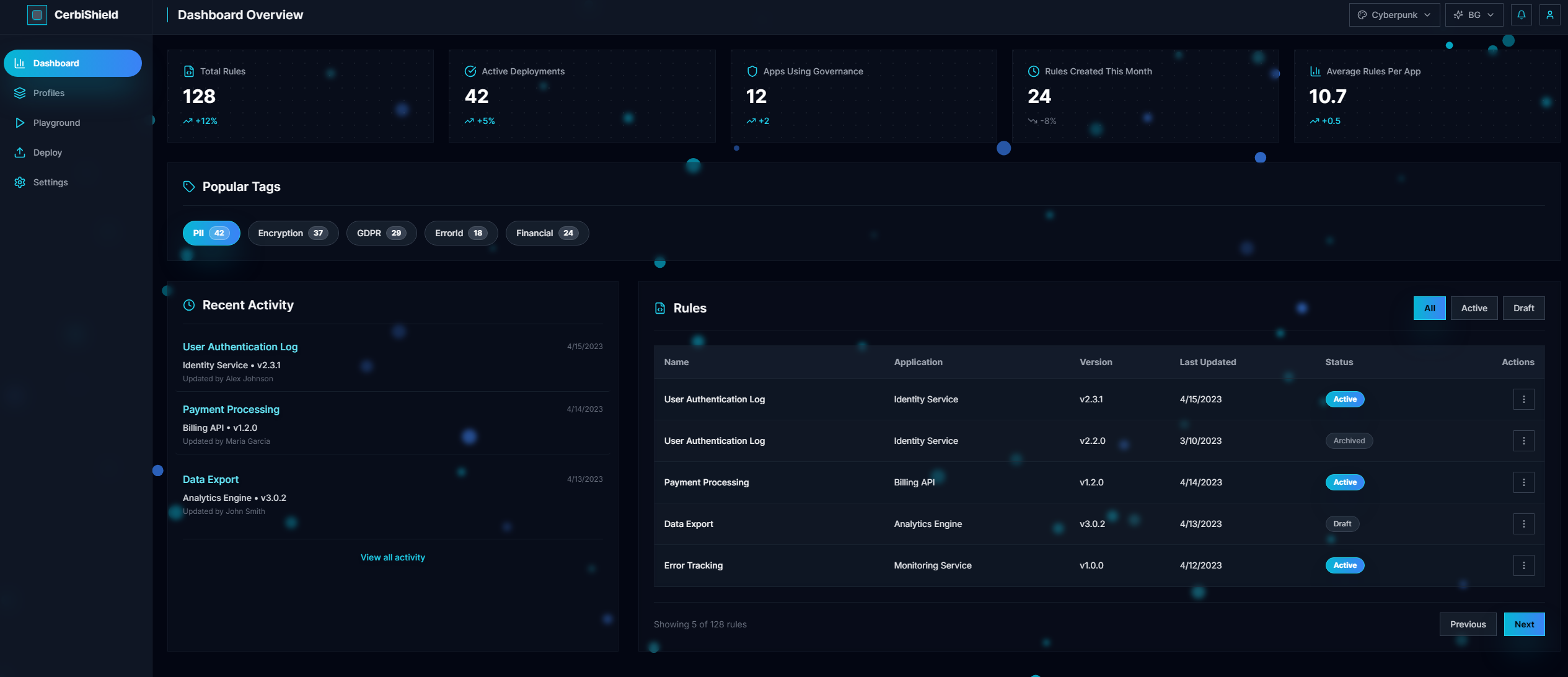
Scores, violations, and governed apps in one tenant-hosted view.
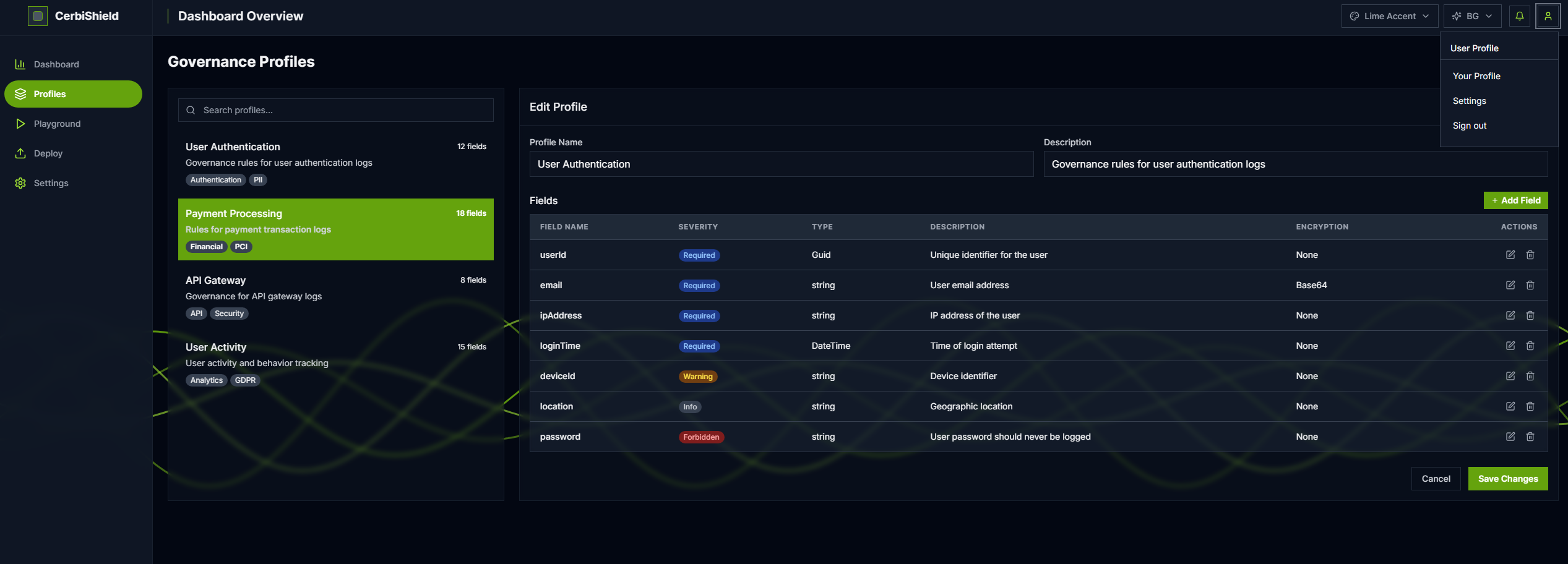
Define required, forbidden, and sensitive fields with versioned governance.
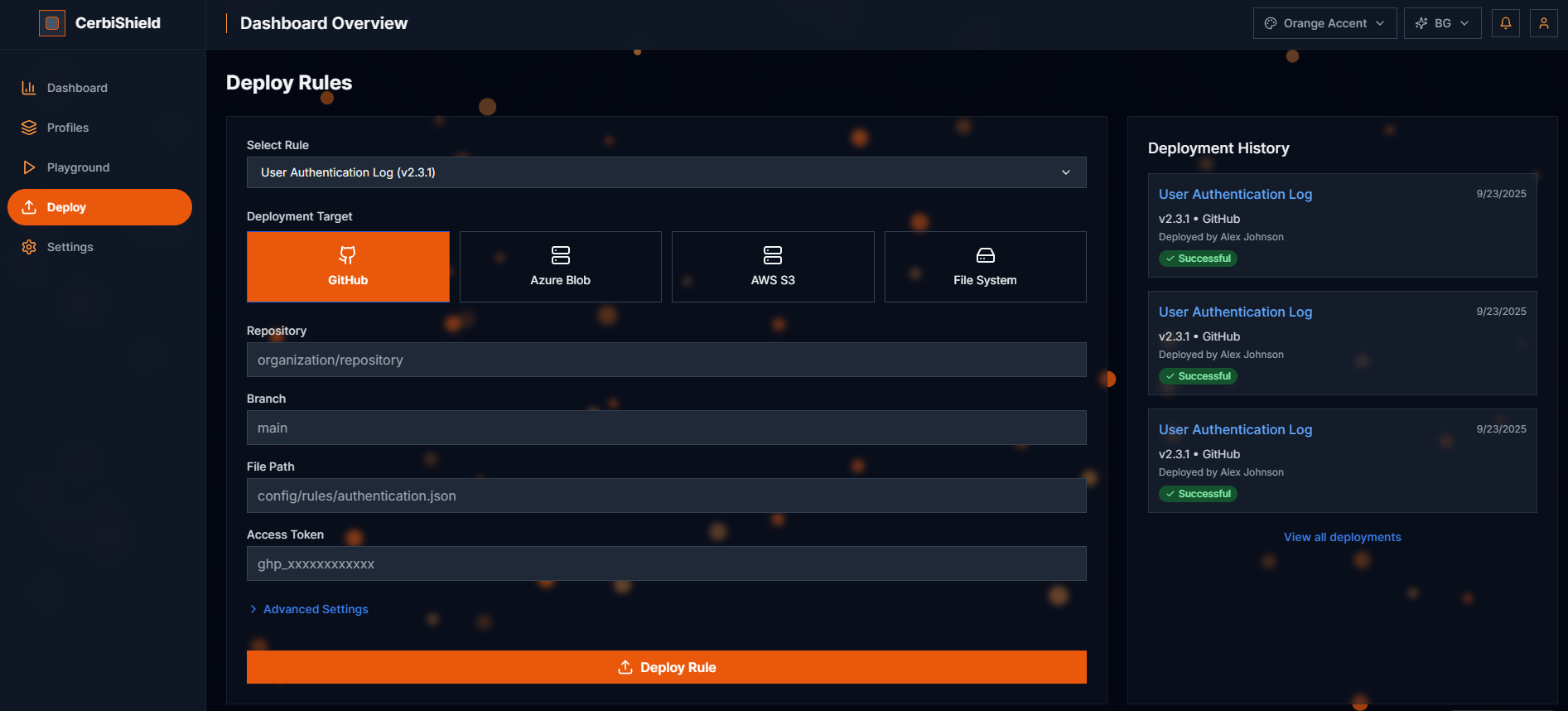
Trace when governance changes moved to each governed application.
Short, concrete wins you can expect. Each can start small and expand safely across the org.
Outcome examples are illustrative pilots grounded in governance controls, redaction posture, schema stability, and audit evidence; expect variance by stack.
Normalize fields, roll up noise, and de-duplicate before indexing.
Versioned PII policy + redaction metadata you can hand to Risk/Legal.
Stop breaking charts every sprint due to field drift.
Consistent app/env/tenant/trace IDs → faster triage and MTTR.
Clean, governed features for LLMs & models—without PII surprises.
Start with one domain, run in relax-mode, then tighten.
Pricing is based on governed applications — not environments or traffic. One app across dev/test/uat/stage/prod counts as one license.
CerbiStream + CerbiShield provide tenant-hosted structured logging governance. Cerbi does not route logs to vendors; you keep your collectors and destinations.
What counts as an app? A single governed application or service, even if it spans dev/test/uat/stage/prod. When microservices are governed separately, they count individually.
Pricing is by governed applications — not environments or traffic. One app across dev/test/uat/stage/prod counts as one license.
Validate CerbiStream locally with baseline governance and redaction patterns.
Add lightweight RBAC and CI enforcement for small teams.
Most popular for platform teams standardizing schemas with traceable history.
For large estates needing governed reporting and broader app coverage.
Pricing is provisional for Marketplace previews; final terms, limits, and SLAs will be confirmed in order forms or private offers. Cerbi governs schemas and redacts/tag payloads but leaves log routing entirely under your control.
Get quick answers to common questions about CerbiSuite. Still have questions? Contact us below.
No. CerbiStream is a governance-first logger. While traditional loggers focus on capturing data, CerbiStream adds built-in governance, compliance validation, PII redaction, and ML-ready structured output. Think of it as a logger + compliance engine + data quality platform in one.
CerbiStream uses familiar .NET logging abstractions and can run alongside Serilog, NLog, or MEL during rollout. You can enable Cerbi for a subset of services first, validate governance profiles, and then expand as you gain confidence. Many teams can prototype integration in a day or less, but full cut-over timing depends on your codebase and the governance rules you choose to enforce.
CerbiStream writes logs to destinations you configure (files, databases, queues, SIEMs) inside your environment. We don’t operate a centralized log-ingestion SaaS, and we don’t have access to your application log payloads. Optional analytics features can work on derived governance metadata if you explicitly enable them, but raw logs remain under your control.
CerbiStream is designed to stay off the hot path. Logging uses async Channel-based buffering so application threads aren’t blocked, and governance validation runs in the background. In our BenchmarkDotNet tests on typical .NET workloads, CerbiStream’s overhead was comparable to established .NET loggers. Exact numbers depend on your payloads, sinks, and governance rules.
CerbiStream targets .NET 8 and .NET 9 on NuGet, with computed compatibility forward to .NET 10+. Older services on .NET 6 or .NET 7, as well as legacy .NET Framework apps, can integrate through the Microsoft.Extensions.Logging abstractions or adapter patterns, but first-class support and testing focus on the current runtimes.
CerbiStream core and the shared governance libraries (for example, Cerbi.Governance.Core and Cerbi.Governance.Runtime) are open source under the MIT license. CerbiShield (the governance dashboard, APIs, reporting, and scoring) is licensed commercially per governed application—not per environment—and includes support and SLAs. Check each repo or NuGet page for the exact license; runtime pieces are permissive, governance/dashboard/scoring are paid.
Datadog and ELK are observability platforms that consume logs. CerbiSuite focuses on log creation and governance at the source. Use CerbiStream to create high-quality, compliant logs, then send them to Datadog, ELK, or any other platform. We complement observability tools; we don't replace them.
Absolutely! Use our 60-second Quick Start to install CerbiStream via NuGet and try it locally. For enterprise features, request a demo and we'll set up a sandbox environment with your data. No commitment required.
Enforce policies, validate payloads, and score redaction posture while your agents, collectors, and log destinations stay the same.
Cerbi complements Serilog, NLog, and Microsoft.Extensions.Logging by governing payloads before they hit your log destinations. Instead of relying on ad-hoc masking, Cerbi combines policy, analyzers, runtime guards, versioning, and scoring so redaction is one layer in a governed pipeline you keep routing.
Define Required, Disallowed, and Sensitive field rules for every log shape so schemas are intentional and sensitive data is controlled by policy—not best-effort filters.
Roslyn analyzers flag violations in CI before code ships, blocking schema drift and risky fields while keeping your existing logger configuration.
Runtime validators enforce the same rules in production, redacting or tagging violations so payloads stay compliant without changing your transport.
Versioned policies with deployment traceability show who changed what and where it’s enforced, keeping governance decisions auditable release over release.
Scoring surfaces schema consistency, redaction posture, and coverage trends so teams can prove improvements and spot regressions quickly.
Schema chaos blows up dashboards and on-call. Cerbi standardizes payloads at the source and flags drift before it ships—result: stable signals and calmer incidents.
Sensitive-data risk and missing audit evidence stall reviews. Cerbi enforces and versions policies in CI/runtime and records deployment history—result: traceable redaction posture you can hand to auditors.
Cross-team inconsistency slows releases. Cerbi keeps schemas versioned outside code, scores adherence, and blocks regressions in CI—result: consistent logs and faster approvals.

I’m Tom, a principal architect who’s spent years untangling .NET logging in regulated environments — healthcare, payments, and cloud platforms that actually get audited. Cerbi is the logging and governance layer I kept sketching on whiteboards and never got from vendors, so I built it.
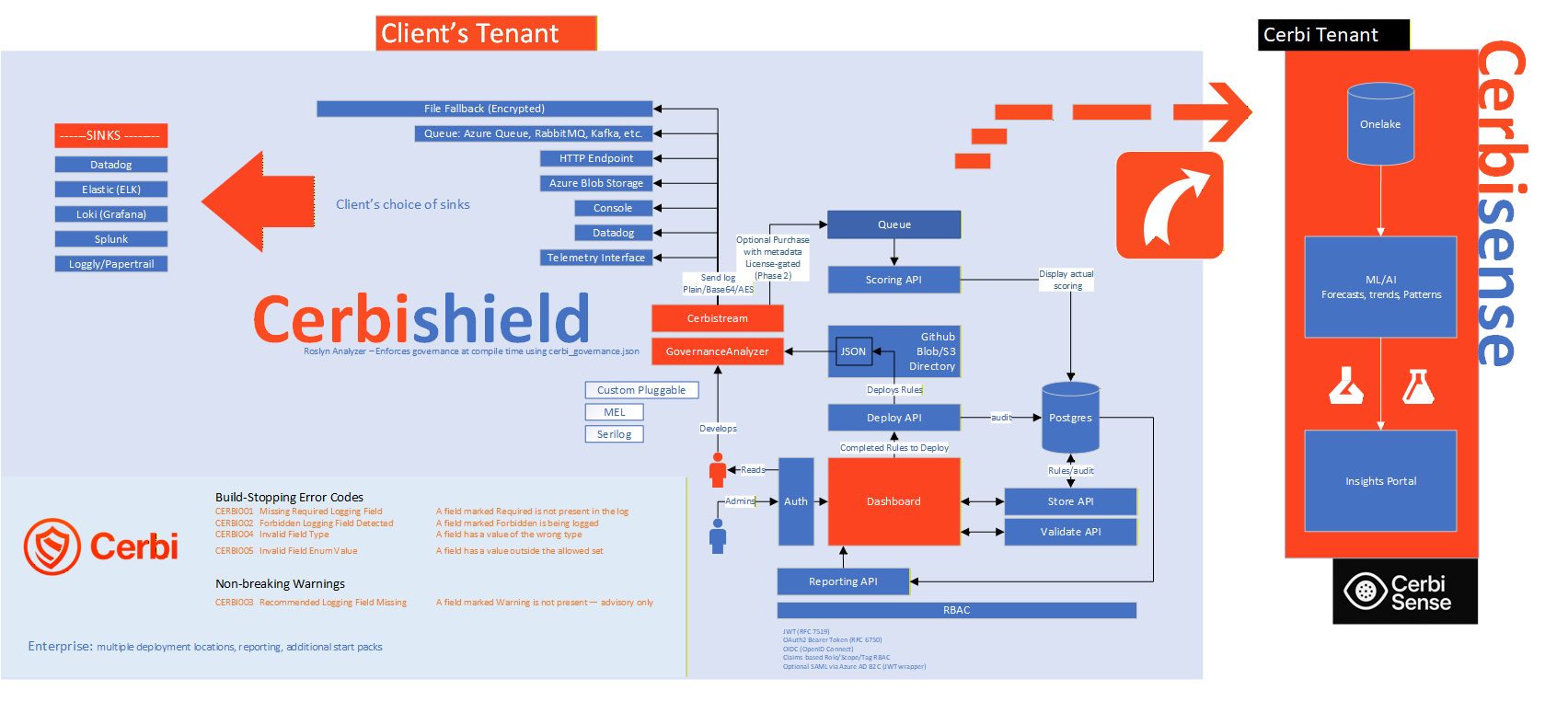
CerbiStream runs in your .NET services. CerbiShield runs in your tenant. You keep your log destinations. Cerbi gives you governed, PII-safe, audit-ready telemetry without dropping another black-box SaaS in the middle.
CerbiStream is a governance-first logging layer for .NET that validates, redacts, and tags every log event before it hits your log platforms. Instead of shipping “whatever the app logs” into expensive platforms, Cerbi enforces JSON profiles so only clean, compliant, ML-ready data flows downstream. CerbiShield is the tenant-hosted governance brain and scorecard layer that defines, versions, and deploys those profiles with RBAC and audit history—customers own the infrastructure and data plane while policy stays outside code. The Scoring API is the governance scoring engine that tracks posture over time. Together, they turn logging from an ungoverned cost center into an auditable, measurable part of your architecture without ever routing your traffic.
| Product | Type | Where it runs | License |
|---|---|---|---|
| CerbiStream | .NET logging library | In your apps/services | OSS (MIT) |
| Cerbi.Governance.Runtime | Engine | In your apps/services | OSS (MIT) |
| CerbiShield | Governance brain + dashboards | In your Azure tenant | Commercial |
| Scoring API | Governance scoring service | In your Azure tenant | Commercial |
Cerbi was designed for regulated workloads. Governance profiles let you define required, forbidden, and disallowed fields, plus redaction rules, so PII and PHI don’t leak into your log pipeline by accident. CerbiShield lets you version and deploy these profiles per app and environment, so auditors can see exactly what is enforced and where. We don’t promise “automatic compliance”—instead, we give you the guardrails and evidence you need to pass real audits.
AES-256 file encryption is available for fallback logs, and Cerbi fits cleanly into TLS-secured infrastructure. Exact cipher suites and TLS versions are controlled by your hosting platform and configuration. Cerbi does not weaken your existing security posture.
Rule-based redaction identifies and masks sensitive fields before they are written to your log destinations. Governance profiles keep PII and PHI out of your log payloads by design. Optional analytics and future ML components can build on the same metadata, but core redaction is explicit and policy-driven.
Built-in audit trails and governance metadata are designed to help you address common SOC 2 Type II, HIPAA, GDPR, and ISO 27001 logging controls. Cerbi itself is not a substitute for legal review or formal certification, but it gives your security and compliance teams the evidence they expect from a modern logging layer.
Catch governance violations quickly. Cerbi tags events with structured violations so your pipelines (OTel, Fluent Bit, Vector, custom collectors) can forward alerts into your existing stack (Splunk, Datadog, ELK, Grafana, etc.) before issues become incidents or audit findings.
By default, Cerbi runs entirely in your tenant so logs stay in your environment. Optional analytics services can consume derived metadata if you choose to enable them, but Cerbi does not ship your raw logs to shared SaaS by default.
Append-only audit trails are designed to be stored in immutable or WORM-capable storage, making access and changes tamper-evident during investigations and audits.
Cerbi doesn’t try to be your AI platform. It focuses on producing clean, structured, governance-tagged logs that any AI stack can consume. Whether you’re using Databricks, OpenSearch, self-hosted RAG, or vendor LLMs, Cerbi adds consistent fields like GovernanceViolations, GovernanceProfileUsed, and GovernanceRelaxed so downstream analysis and scoring stay predictable. You decide which models to run and where; Cerbi simply makes the data safe and usable.
As organizations scale across internal squads, contractors, and third-party libraries, logging becomes a patchwork—hard to trust, hard to use, and risky. Cerbi turns logs into governed, reliable data products.
| Approach | Pros | Cons | Best when… |
|---|---|---|---|
| "Just log more" | Fast to start | Inconsistent fields, PII risk, higher cost | Tiny apps, prototypes |
| Downstream normalization | No app changes | Late fixes, fragile | Short-term stopgap |
| Cerbi governance | Stable schema, redaction, versioned policy | Define profiles; add analyzers/validators | Multi-team apps, compliance |
A cohesive suite where each component addresses a critical aspect of enterprise logging.
| Component | Status | Purpose |
|---|
From runtime validation to dashboard visualization—governance signals flow to the Scoring API while your log routers keep sending payloads to the destinations you already trust.
Runtime validators and governance plug-ins grade each log against profile rules, compute the ScoreImpact, and tag the event before your router ships it.
Minimal scoring payloads (no PII) ship asynchronously to the Scoring API for ingest/normalize/compute ScoreImpact—non-blocking, batched, and separate from your payload routing.
Scoring API ingests the score metadata asynchronously and persists it to CerbiShield via Store APIs with RBAC and timestamps.
CerbiShield Reporting APIs roll up scores by service, environment, team, and time window.
CerbiShield displays trends, violations, and scorecards with drill-downs.
A clear four-step loop that keeps schema consistency, redaction posture, and governance enforcement measurable—without changing how you route logs.
The Scoring API is the governance signal normalization + scoring engine. The legacy “CerbIQ-as-router/normalization/fan-out” story is fully retired—CerbIQ is deprecated. Cerbi never brokers, forwards, or replaces your transport to Splunk, Datadog, ELK, OpenSearch, or any other sink.
Cerbi is not a log transport layer and does not require pipeline changes. Customers keep their existing routing (Kafka, Event Hubs, Vector, Fluent Bit, HTTP collectors, or anything else) while Cerbi layers governance, validation, and scoring metadata on top—your pipelines continue delivering payloads to vendors unchanged.
Platform and SRE teams get provable guardrails without re-platforming: consistent schemas, reduced incident blast radius from bad payloads, faster RCA from scored violations, and clearer ownership around who is enforcing what.
Clear problems, concrete solutions—for executives, security teams, and developers.
Observability cost anxiety driven by noisy, unstructured logs and accidental ingestion.
Reduce noise before ingestion with schema-first governance and routing guardrails that keep traffic intentional.
Sensitive data redaction is brittle—manual rules drift and teams lack proof it’s working.
Make redaction automatic with versioned policies, analyzers, and runtime validators that score coverage on every build.
Misconfigurations lead to schema drift, broken dashboards, and surprise ingestion across log destinations.
Stop schema drift and turn governance into CI + runtime guardrails so dashboards, alerts, and pipelines stay predictable.
CerbiStream governs telemetry at the source, CerbiShield defines and deploys governance policy, and the Scoring API measures posture—your existing pipelines keep routing to log destinations and vendors you already trust.
builder.AddCerbiStream() adds structured output + governance.Friendly reminder from the engineering team:
Cerbi enforces governance at the source and attaches scoring signals so the tools you already use receive cleaner, consistent data.
Install the core Cerbi packages directly from NuGet using the commands below.
Governance-enforced structured logging for .NET with optional file fallback and encryption.
Roslyn analyzer that enforces Cerbi governance rules at build time.
Runtime governance adapter for Microsoft.Extensions.Logging (MEL).
Shared contracts and enums that keep analyzers, runtime validators, and dashboards aligned.
Runtime governance engine that evaluates Cerbi profiles and emits violation metadata.
Serilog governance plugin that enforces Cerbi profiles at runtime and ships scoring metadata into CerbiShield.
A deeper walk-through of the CerbiStream implementation, file fallback, governance hooks, and async logging pipeline.
From first log line to governance scores on a dashboard, each piece plays a specific role in the pipeline.
Overview
Stage 1
Stage 2
Stage 3
Stage 4
Stage 5
Routing to external log vendors is outside Cerbi; your pipeline remains in control.
Quick introduction to CerbiSuite's enterprise governance platform and its core capabilities.
Hands-on demonstration of CerbiStream's structured logging capabilities and real-time monitoring.
Walk through how CerbiStream, the analyzers, runtime validators, and CerbiShield fit together in a real deployment pipeline, and what’s coming next.
How Cerbi keeps sensitive scoring data governed end-to-end while preserving observability fidelity.
Browse every walkthrough, webinar, and launch clip directly on our channel. New uploads appear here automatically.
A candid walkthrough for leaders and architects on where Cerbi fits: what problem it solves, what it doesn’t do, and how it plugs into the stack you already have.
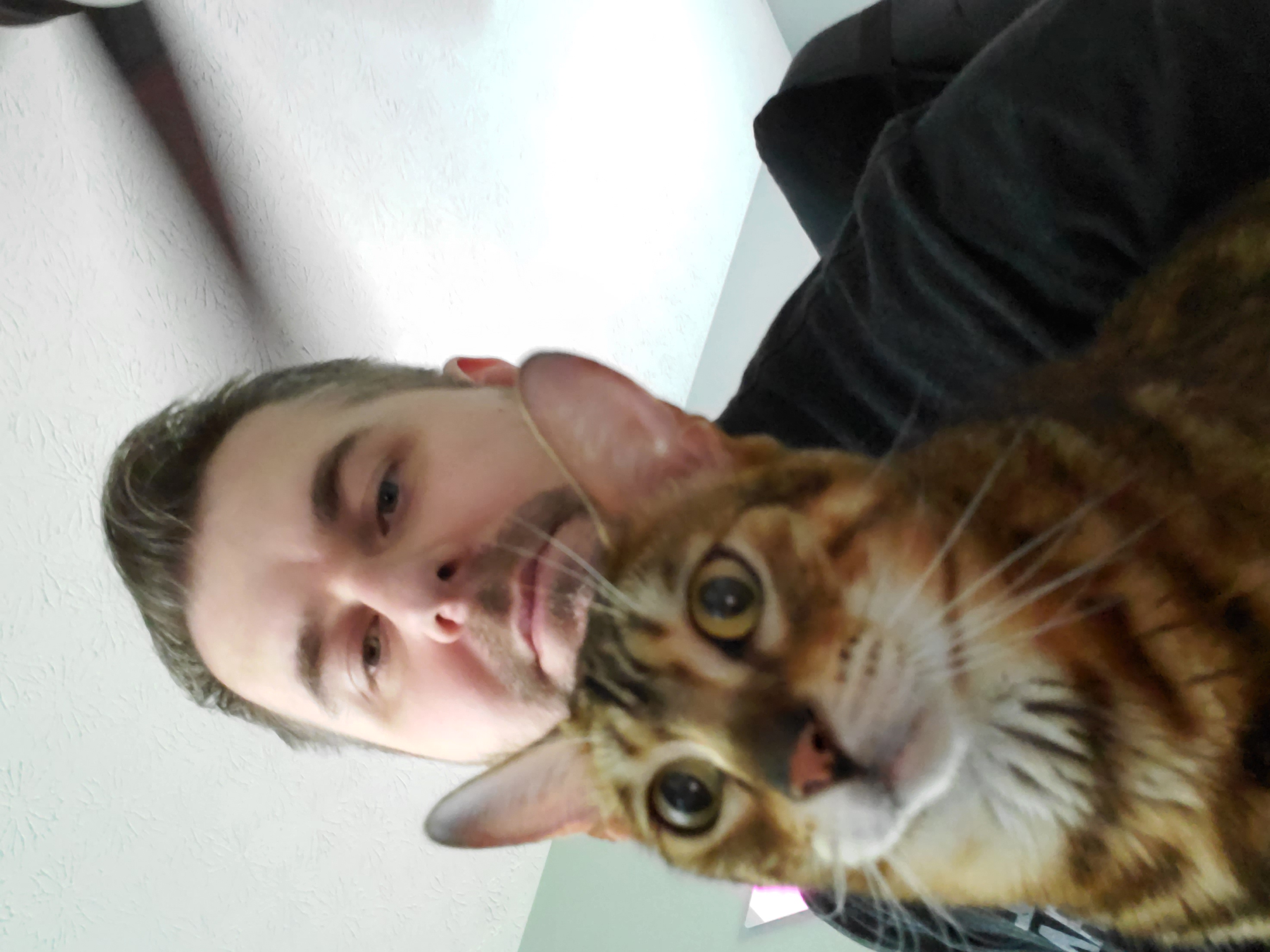
Hi, I’m Tom Nelson — principal architect, Cerbi founder, and the one to blame for the phrase “governed telemetry.” Cerbi started as a nights-and-weekends experiment to stop our .NET logs from turning into an expensive, ungoverned mess.
Most of my work has been in regulated stacks — healthcare, insurance, payments — where “we’ll fix the logs later” usually means “we’ll suffer during the audit.” Cerbi is my answer to that: make logging predictable, compliant, and actually useful instead of noisy.
The supervising fur team is Leo and Cora. They don’t care about log volume, but they absolutely care if I miss dinner or break a dashboard on purpose to test governance.

Questions, enterprise inquiries, partnerships, or funding conversations? Send a note and we'll respond quickly.